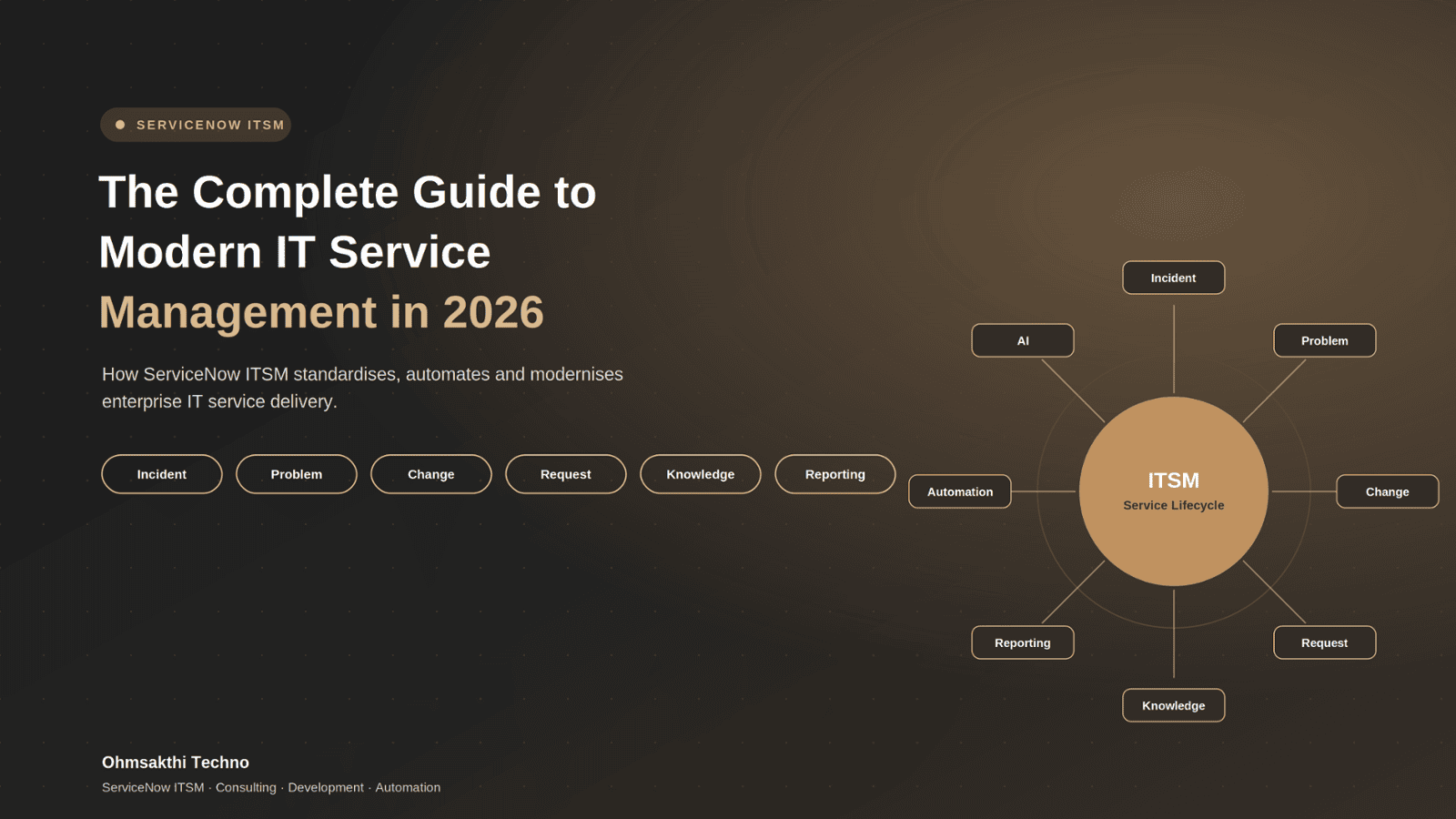
ServiceNow ITSM: The Complete Guide to Modern IT Service Management in 2026
Introduction: Why Modern IT Service Management Matters
Modern businesses depend on technology to manage customer relationships, financial operations, employee productivity, cybersecurity, communication, and day-to-day business processes. As organisations adopt more applications and cloud-based platforms, managing IT services becomes increasingly complex.
Traditional IT support models often rely on manual ticket handling, disconnected tools, email-based requests, and reactive troubleshooting. These approaches can lead to delayed resolutions, repeated incidents, poor visibility, and unnecessary operational costs. This is where ServiceNow ITSM (IT Service Management) can make a significant difference.
ServiceNow ITSM helps organisations standardise IT service delivery, automate repetitive processes, improve incident management, streamline change requests, and provide employees with a more consistent support experience.
In 2026, the opportunity extends beyond ticket management. Organisations can combine ITSM with workflow automation, integrations, analytics, and AI capabilities to build more proactive and intelligent IT operations. For organisations planning to modernise their IT environment, understanding ServiceNow ITSM is an important first step.
What Is ServiceNow ITSM?
ServiceNow ITSM is a technology solution designed to help organisations manage and improve the delivery of IT services throughout their lifecycle.
Built on the ServiceNow, it provides a centralised environment for handling IT incidents, service requests, problems, changes, and knowledge resources.
Instead of relying on disconnected tools and manual communication, businesses can use structured workflows to coordinate IT support activities, track progress, and improve service delivery.
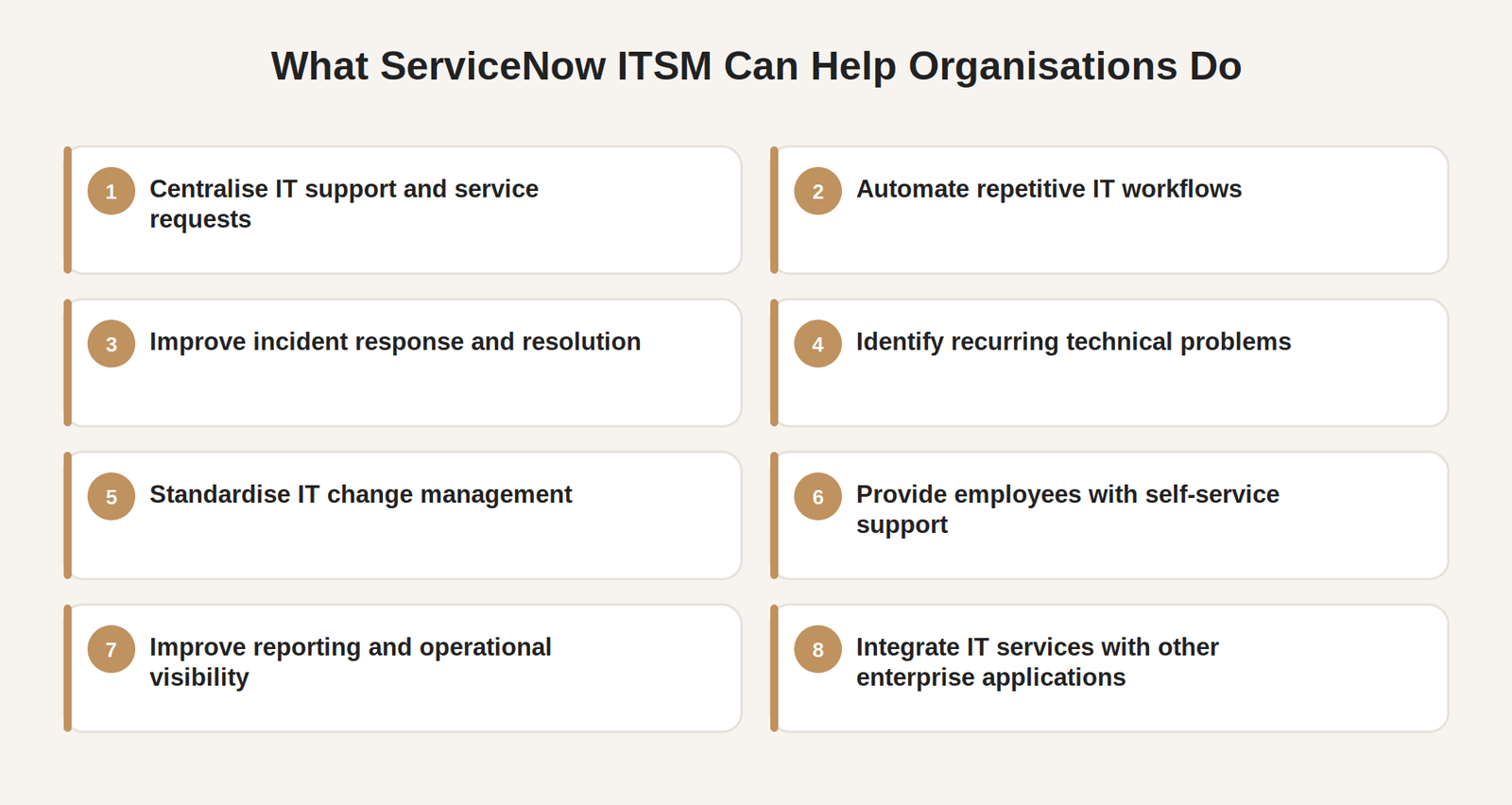
ServiceNow ITSM can help organisations:
- Centralise IT support and service requests.
- Automate repetitive IT workflows.
- Improve incident response and resolution.
- Identify recurring technical problems.
- Standardise IT change management.
- Provide employees with self-service support.
- Improve reporting and operational visibility.
- Integrate IT services with other enterprise applications.
Related Post
THE FUTURE OF ENTERPRISE IT IN 2026
ServiceNow Development Outsourcing
ServiceNow Implementation
Zoho business solutions and automation
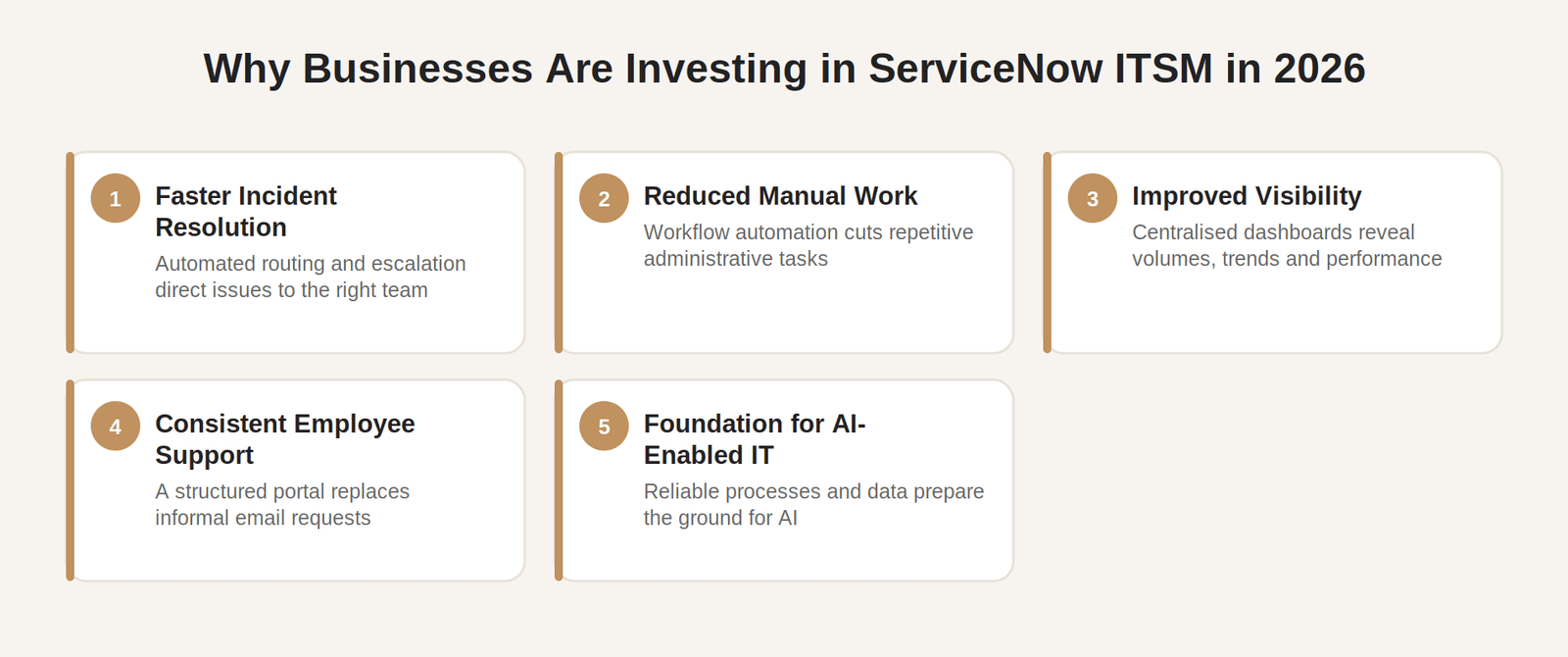
Why Businesses Are Investing in ServiceNow ITSM in 2026
IT environments are becoming more distributed. Employees work across offices, remote locations, cloud platforms, and multiple business applications. IT teams must maintain service quality while managing security, operational complexity, and increasing expectations from employees and customers.
1. Faster incident resolution
When employees experience technical issues, delays can affect productivity and business continuity. ServiceNow ITSM helps support teams record, categorise, prioritise, assign, and track incidents through defined workflows.
2. Reduced manual work
Many IT tasks follow predictable patterns, including password-related requests, software access approvals, equipment requests, and employee onboarding activities.
3. Improved visibility across IT operations
Centralised dashboards and reporting can help IT managers understand ticket volumes, outstanding incidents, resolution trends, recurring issues, and service performance.
This supports more informed decisions about staffing, process improvement, and technology investments.
4. Consistent employee support
A well-designed service portal gives employees a structured way to request support, access knowledge articles, and monitor the status of their requests.
This can reduce dependence on informal email conversations and improve the overall support experience.
5. A foundation for AI-enabled IT operations
AI capabilities can support activities such as knowledge discovery, summarisation, request classification, and selected workflow tasks, depending on the products and licences deployed.
Organisations should establish reliable processes, data quality, access controls, and governance before expanding into more advanced AI-enabled workflows.
Core ServiceNow ITSM Modules Every Business Should Understand
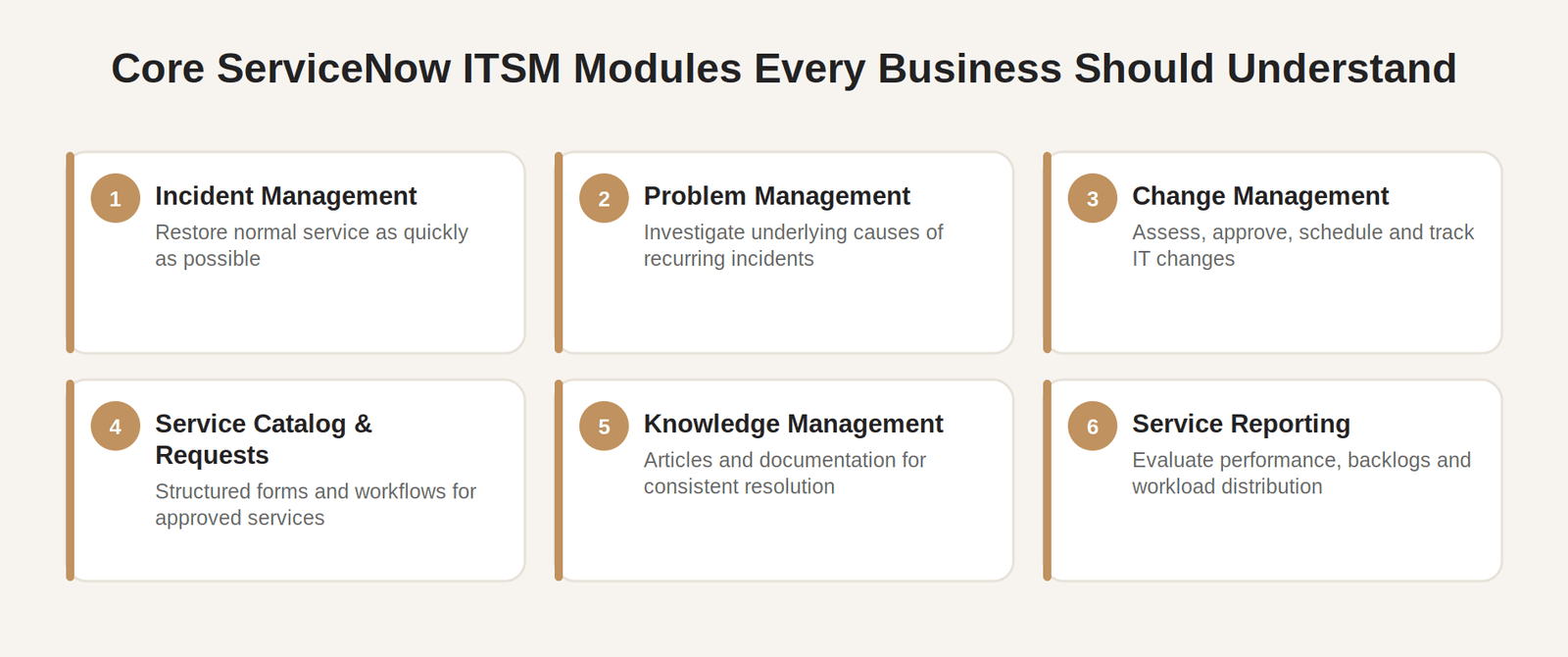
ServiceNow ITSM includes capabilities that address different stages of IT service delivery. The exact functionality available depends on the product edition, configuration, and licensing.
1. Incident Management
Incident Management focuses on restoring normal service as quickly as possible when an IT disruption occurs.
Examples include application failures, network outages, email access issues, and employee device problems.
2. Problem Management
Problem Management investigates the underlying causes of incidents, particularly when issues recur or affect multiple users.
For example, repeated application failures may require a root-cause investigation rather than repeated ticket closure.
3. Change Management
Change Management helps organisations assess, approve, schedule, and track changes to IT services and infrastructure.
Examples include application releases, infrastructure updates, configuration changes, and security patches.
4. Service Catalog and Request Management
A service catalog allows employees to request approved services through structured forms and workflows.
Common examples include software access, new equipment, application permissions, and standard IT services.
5. Knowledge Management
Knowledge Management enables IT teams to create and maintain articles, troubleshooting instructions, and support documentation.
Employees and support agents can use this information to resolve common issues more consistently.
Business benefit:
Better self-service, improved knowledge sharing, and reduced dependence on individual team members.
6. Service Reporting and Performance Management
Reporting helps teams evaluate service performance, ticket backlogs, recurring incidents, resolution patterns, and workload distribution.
Business benefit: More measurable IT operations and better opportunities for continuous improvement.
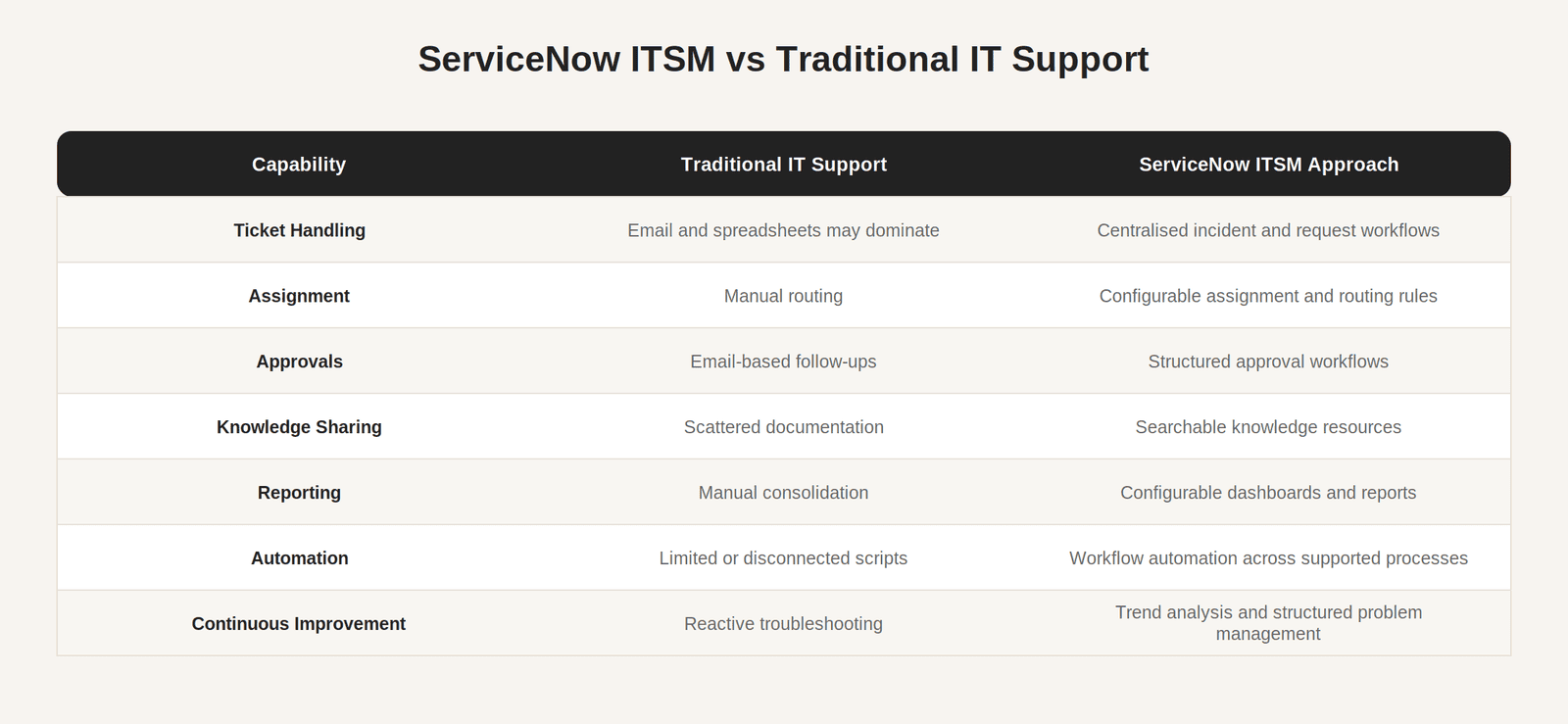
ServiceNow ITSM vs Traditional IT Support
Traditional IT support is often built around manual communication and reactive ticket handling. A modern ITSM platform creates a more structured operating model.
The benefits depend on how well the platform is designed, implemented, adopted, and maintained. Simply purchasing ServiceNow does not automatically eliminate manual work or guarantee improved service levels.
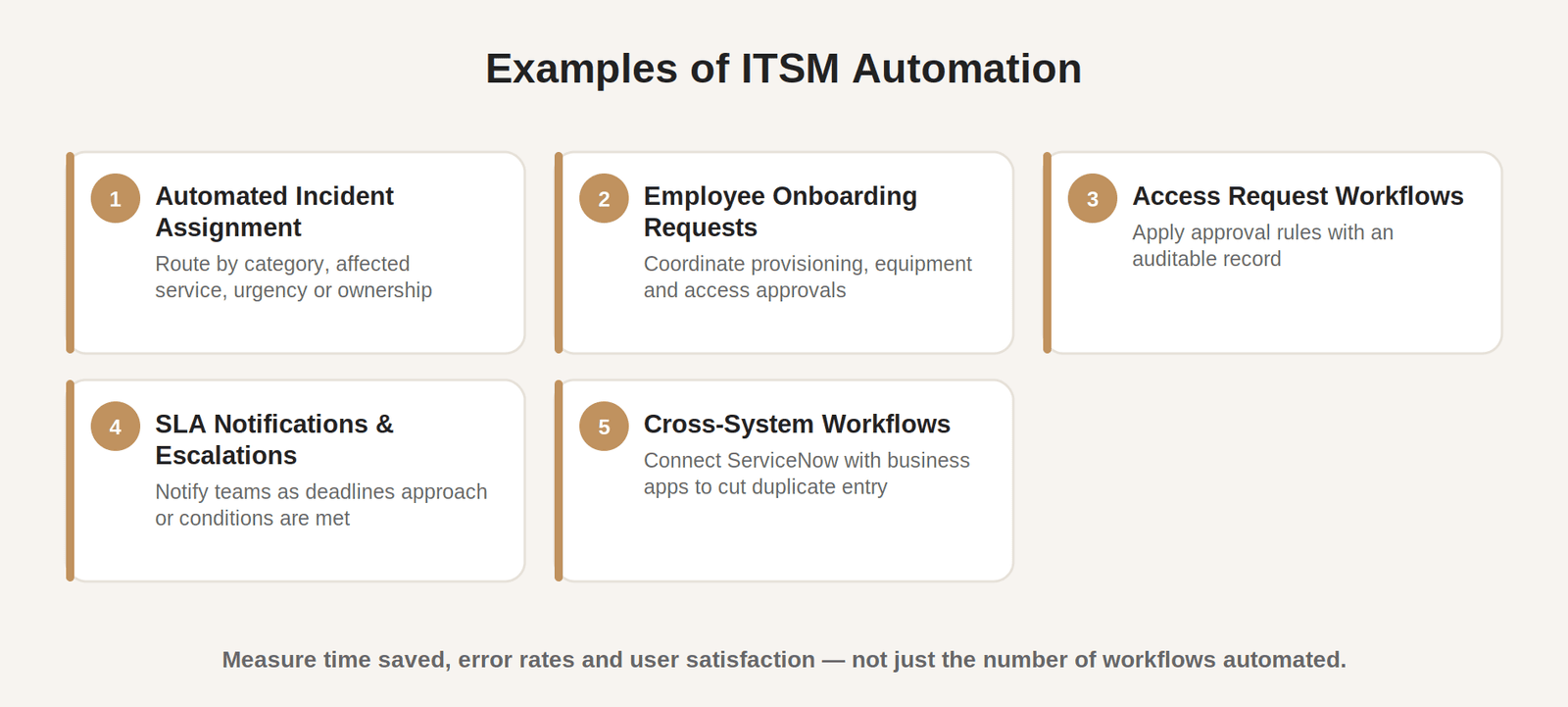
How ServiceNow ITSM Automation Improves Business Operations
Automation is one of the most important opportunities within an ITSM transformation.Businesses should identify repetitive, rules-based tasks that consume support-team time and introduce automation where it produces measurable operational value.
Examples of ITSM automation
Automated incident assignment Route incidents according to category, affected service, urgency, or support ownership. Employee onboarding requests Coordinate account provisioning, equipment requests, access approvals, and relevant notifications across connected systems. Access request workflows Apply approval rules and maintain an auditable record of access requests and decisions. SLA notifications and escalations Notify the relevant teams when service-level deadlines approach or defined escalation conditions are met. Cross-system workflows Connect ServiceNow with approved business applications to reduce duplicate data entry and coordinate service delivery.
The Role of AI in ServiceNow ITSM in 2026
AI is changing how IT teams interact with service management platforms. Depending on the ServiceNow capabilities licensed and enabled, AI may assist with knowledge retrieval, incident summarisation, classification, recommended actions, and selected workflow activities.
More advanced AI-agent capabilities may support multi-step tasks within defined permissions and controls.
However, AI should not be treated as a replacement for a sound ITSM foundation.
Before deploying AI-enabled workflows, businesses should consider:
- Data quality: Knowledge articles, service records, and configuration data must be reliable.
- Access control: AI-assisted actions must respect permissions and security policies.
- Human oversight: Sensitive or high-impact actions may require review or approval.
- Auditability: Organisations should be able to review important actions and decisions.
- Measurement: AI deployments should be assessed against clear service and business outcomes.
A practical roadmap is to standardise core ITSM processes first, automate stable workflows next, and introduce AI capabilities where there is a clear use case and appropriate governance. For a deeper discussion, read our related article:
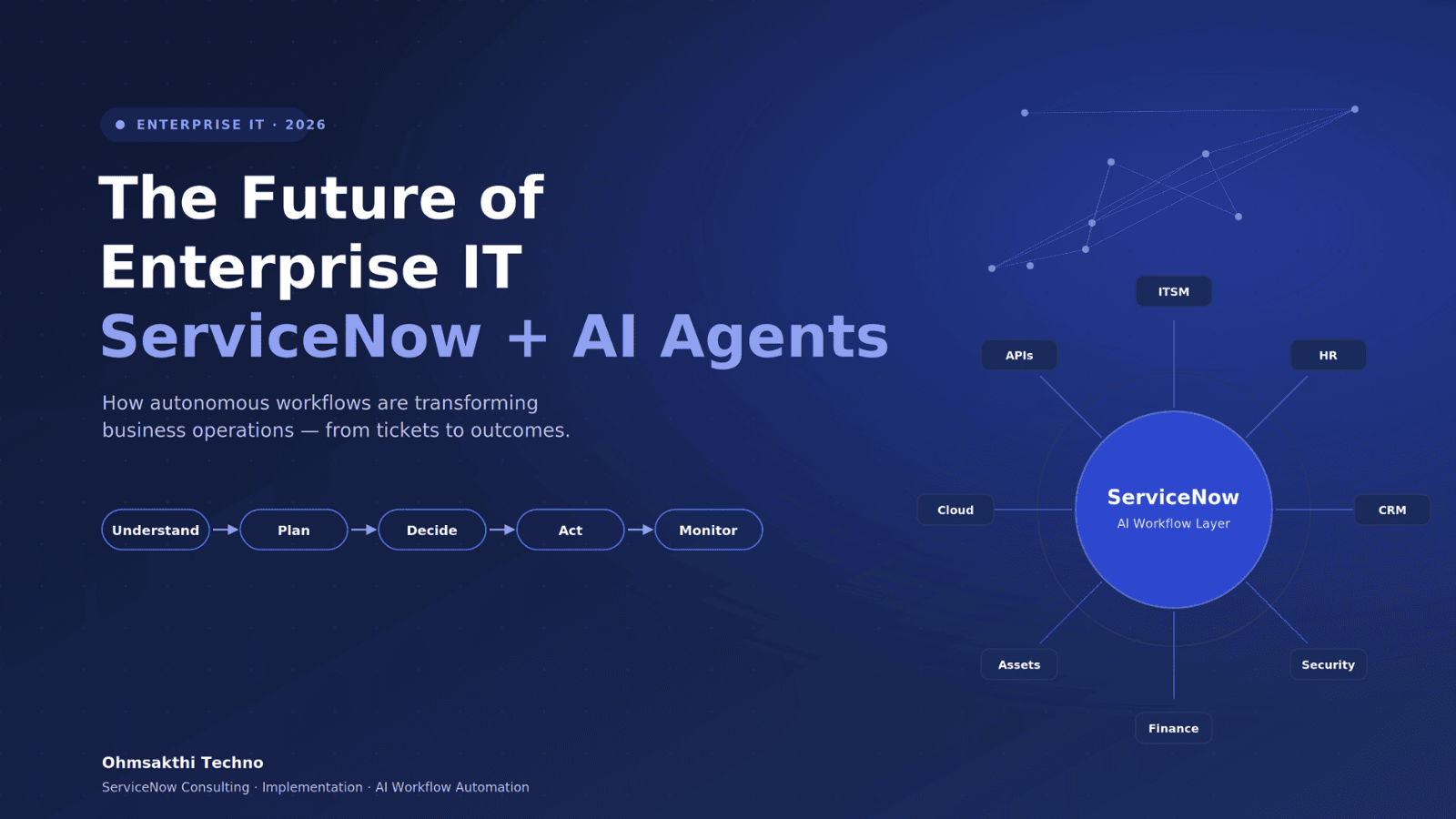
The Future of Enterprise IT in 2026: How ServiceNow and AI Agents Are Transforming Business Workflows.
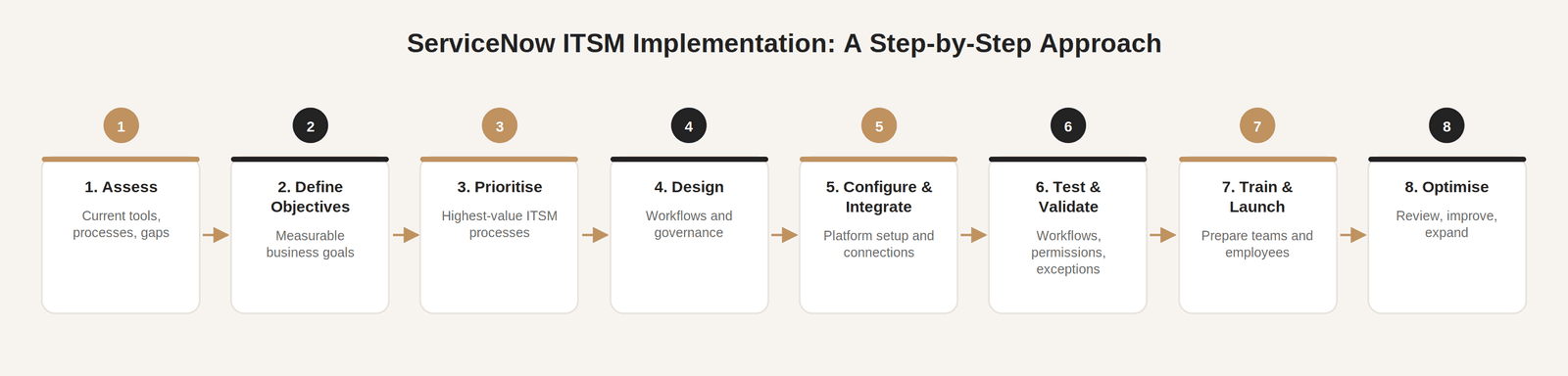
ServiceNow ITSM Implementation: A Step-by-Step Approach
A successful ServiceNow ITSM implementation requires more than platform configuration. It requires alignment between business objectives, existing processes, technical architecture, and user adoption.
- Step 1: Assess the existing IT environment
Document current ticketing tools, service processes, integrations, reporting gaps, and operational pain points.
- Step 2: Define business objectives
Establish measurable goals such as reducing resolution delays, improving service visibility, standardising requests, or reducing repetitive work.
- Step 3: Prioritise ITSM processes
Identify which capabilities should be implemented first. Avoid introducing unnecessary complexity during the initial phase.
- Step 4: Design workflows and governance
Define ownership, escalation rules, approval paths, service priorities, reporting requirements, and security controls.
- Step 5: Configure and integrate the platform
Configure the required ITSM capabilities and connect relevant enterprise systems using appropriate, maintainable integration methods.
- Step 6: Test and validate
Test workflows, permissions, integrations, notifications, reporting, and exception scenarios before launch.
- Step 7: Train users and launch
Prepare support teams, communicate process changes, and provide employees with clear guidance on using the service portal and support workflows.
- Step 8: Optimise continuously
Review performance data, collect user feedback, address bottlenecks, and introduce additional automation or AI capabilities when appropriate.
Common ServiceNow ITSM Implementation Challenges
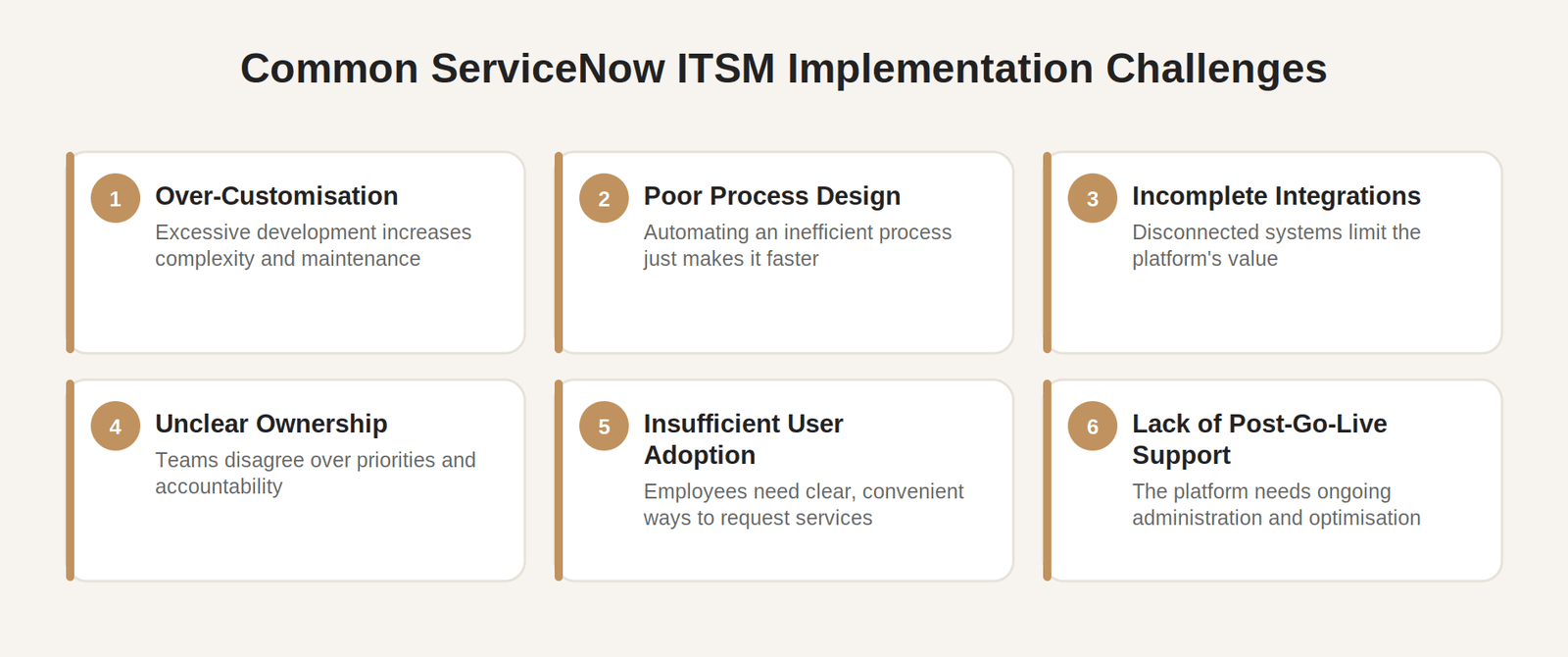
Organisations can encounter challenges when ITSM implementation is approached as a technology installation rather than an operational transformation.
Over-customisation
Excessive custom development can increase complexity and maintenance effort. Businesses should evaluate standard platform capabilities before building custom functionality.
Poor process design
Automating an inefficient process may simply make the inefficiency happen faster. Existing workflows should be assessed before automation.
Incomplete integrations
Disconnected HR, identity, monitoring, asset, and business systems can limit the value of a central ITSM platform. Integration requirements should be addressed early.
Unclear ownership
Without clear process owners, teams may disagree over priorities, approvals, escalations, and accountability.
Insufficient user adoption
Employees need a clear, convenient way to request services. Training, communication, and feedback are important for sustained adoption.
Lack of post-implementation support
A go-live date is not the end of an ITSM transformation. The platform needs ongoing administration, enhancements, monitoring, and optimisation.
How to Choose the Right ServiceNow ITSM Consulting Partner
Choosing an experienced ServiceNow partner can help organisations reduce implementation risks and align platform capabilities with business requirements.
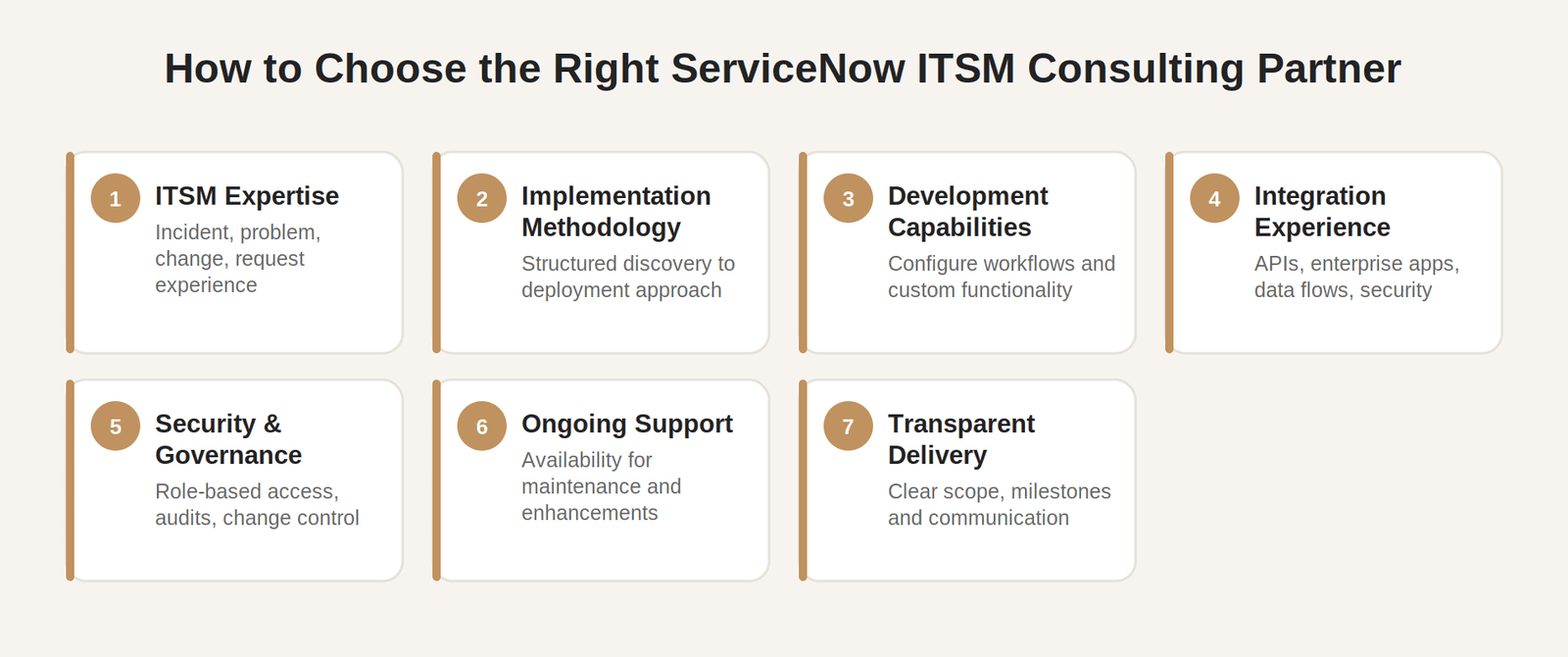
When evaluating a ServiceNow ITSM consulting company, consider the following criteria:
- ITSM expertise: Experience with incident, problem, change, and request management.
- Implementation methodology: A structured approach to discovery, design, configuration, testing, and deployment.
- Development capabilities: Ability to configure workflows, build approved custom functionality, and maintain solutions.
- Integration experience: Understanding of APIs, enterprise applications, data flows, and integration security.
- Security and governance: Attention to role-based access, audit requirements, and change control.
- Ongoing support: Availability of developers and consultants for maintenance, enhancements, and issue resolution.
- Transparent delivery: Clearly defined scope, milestones, responsibilities, communication, and acceptance criteria.
Businesses should also assess the partner's relevant project experience, the skills of the proposed delivery team, and the ability to scale resources as requirements change.
ServiceNow ITSM Consulting and Development Services from Ohmsakthi Techno
At Ohmsakthi Techno, we help businesses explore technology solutions that support operational efficiency, workflow automation, and digital transformation. Our enterprise IT and IT outsourcing focus can support organisations evaluating ServiceNow-related consulting and development requirements.
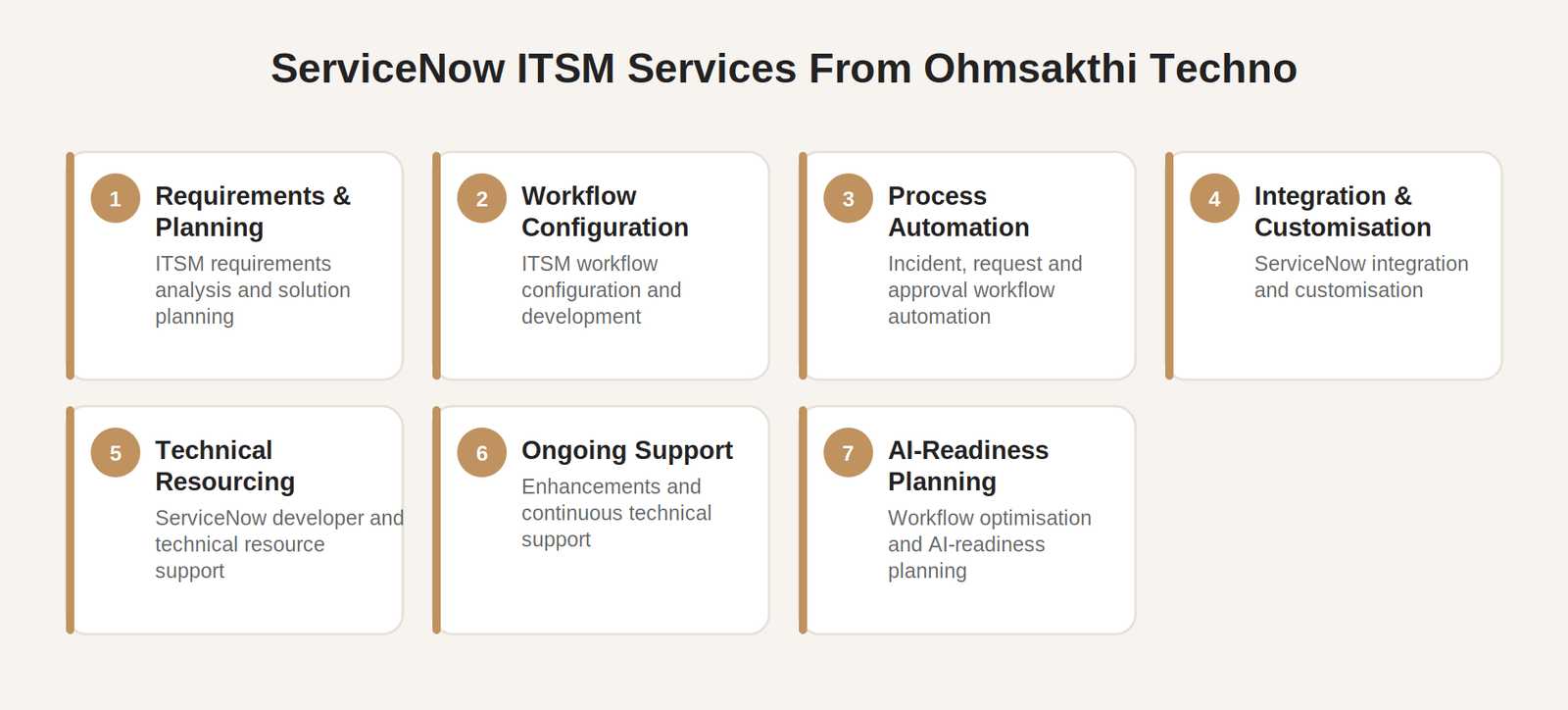
Potential engagement areas include:
- ServiceNow ITSM requirements analysis and solution planning.
- ITSM workflow configuration and development.
- Incident, request, and approval workflow automation.
- ServiceNow integration and customisation.
- ServiceNow developer and technical resource support.
- Ongoing enhancements and technical support.
- Workflow optimisation and AI-readiness planning.
We understand that businesses need solutions aligned with their existing environment, internal capabilities, security requirements, and operational objectives. For organisations in the UK and Europe, remote delivery and flexible resourcing models can also help address specialist development requirements. The appropriate scope, platform capabilities, delivery model, and timeline should be established during an initial technical discussion.
Planning a ServiceNow ITSM project? Contact Ohmsakthi Techno to discuss your requirements and explore a suitable consulting or development engagement.
Suggested CTA buttons for the website:
- Talk to a ServiceNow Expert
- Discuss Your ITSM Requirements
- Hire ServiceNow Developers
Measuring the Success of a ServiceNow ITSM Implementation
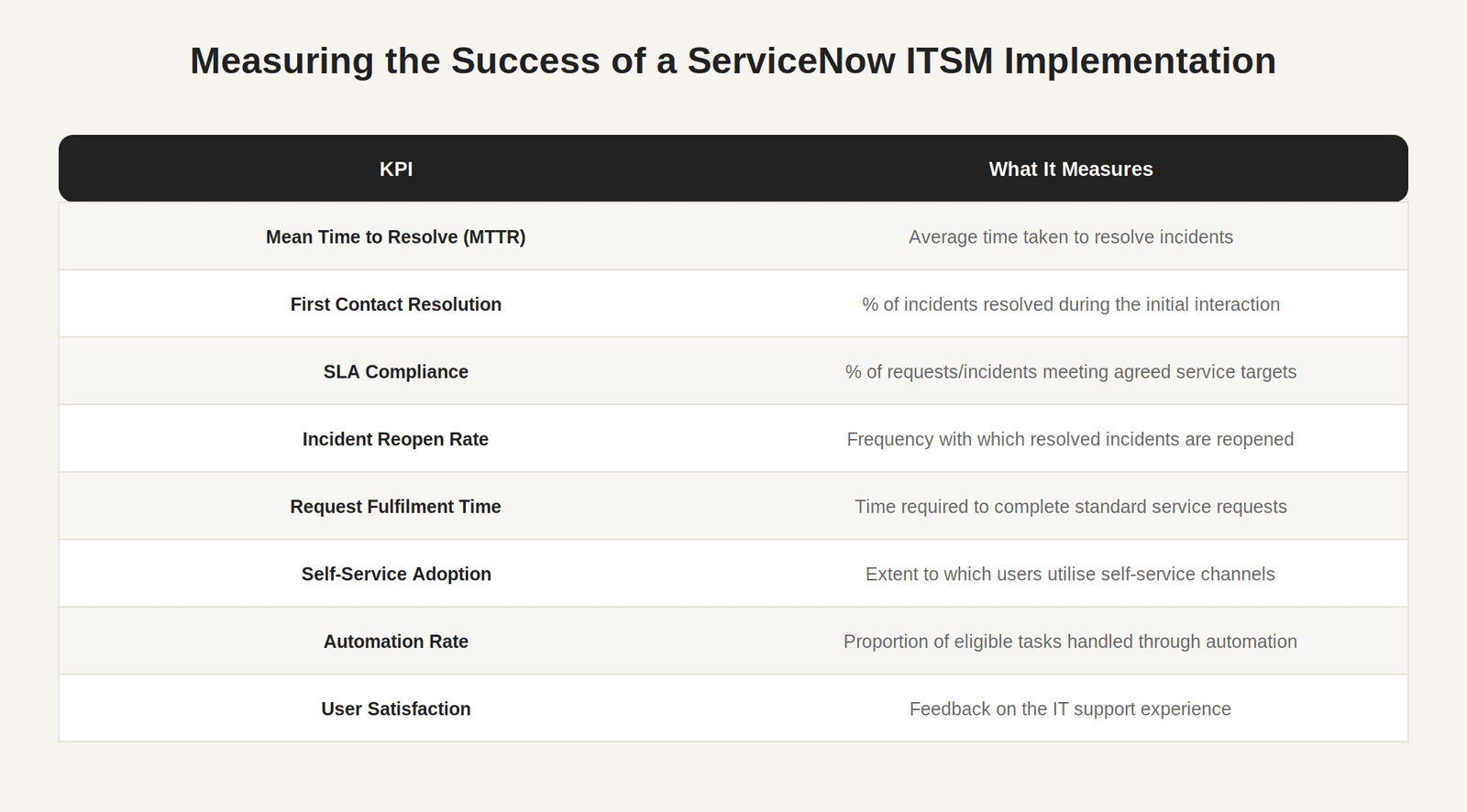
A successful ITSM programme should demonstrate measurable improvements rather than simply track the number of tickets processed.
Organisations should establish baseline values before implementation and set realistic targets based on their operating environment. KPI definitions should remain consistent so that improvements can be measured meaningfully over time.
The Future of IT Service Management
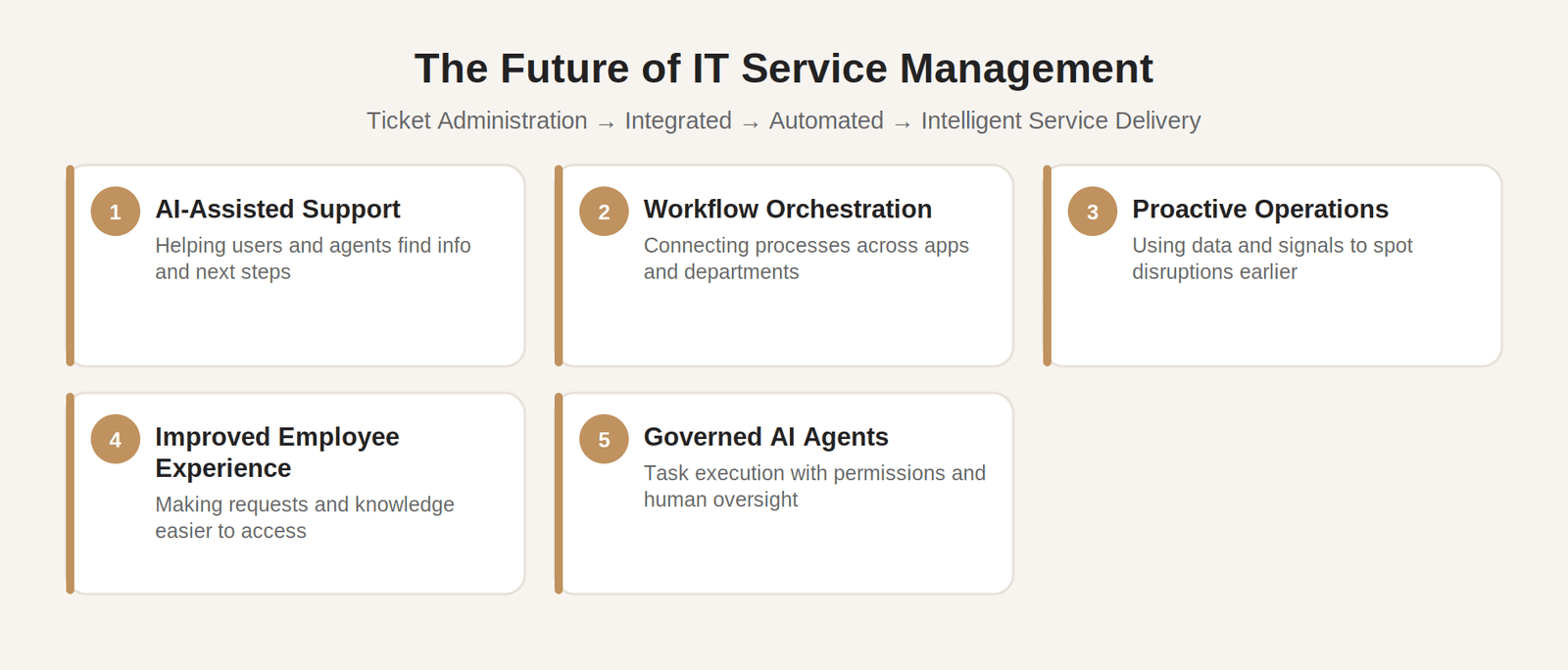
IT service management is evolving from ticket administration towards integrated, automated, and increasingly intelligent service delivery.
Several developments are shaping this evolution:
- AI-assisted support: Helping users and support agents find information, summarise issues, and identify possible next steps.
- Workflow orchestration: Connecting processes across applications and departments.
- Proactive operations: Using service data and monitoring signals to identify potential disruptions earlier.
- Improved employee experience: Making service requests and knowledge resources easier to access.
- Governed AI agents: Introducing AI-driven task execution with appropriate permissions, controls, and human oversight.
Frequently Asked Questions About ServiceNow ITSM
1. What is ServiceNow ITSM used for?
ServiceNow ITSM helps organisations manage IT incidents, problems, changes, service requests, knowledge resources, and related service delivery workflows.
2. What are the main ServiceNow ITSM modules?
Common ITSM capabilities include Incident Management, Problem Management, Change Management, Request Management, Service Catalog, and Knowledge Management. Availability and packaging depend on the relevant ServiceNow offering.
3. Is ServiceNow ITSM suitable for small and medium-sized businesses?
It can be suitable for organisations of different sizes, depending on their process complexity, support requirements, budget, and expected return on investment. Businesses should evaluate the required capabilities and total implementation costs before choosing a solution.
4. How long does ServiceNow ITSM implementation take?
The timeline depends on scope, process complexity, integrations, data readiness, customisation, testing, and organisational readiness. A focused deployment may take less time than a multi-department enterprise transformation. A reliable estimate requires discovery and scope definition.
5. Can ServiceNow ITSM integrate with other business applications?
Yes. ServiceNow supports integration approaches that can connect it with suitable enterprise systems, subject to the capabilities, interfaces, security requirements, and licences involved. Integration design should account for data ownership, error handling, and ongoing maintenance.
6. Can ServiceNow ITSM automate incident management?
Yes. Configured workflows can automate activities such as assignment, notifications, escalations, approvals, and selected remediation processes. The appropriate level of automation depends on the use case and operational controls.
7. What is the difference between ITSM and ITIL?
ITSM is the broader discipline of managing IT services. ITIL is a widely used framework of guidance and practices for effective IT service management. ServiceNow ITSM can be configured to support processes aligned with relevant ITIL practices.
8. Do businesses need a ServiceNow ITSM consultant?
A consultant can help assess requirements, design processes, configure the platform, plan integrations, and establish governance. The level of support required depends on the organisation's internal expertise and project complexity.
9. Can businesses outsource ServiceNow development?
Yes. Businesses can use external developers, dedicated teams, staff augmentation, or project-based delivery to supplement internal capabilities. They should assess technical skills, security practices, delivery governance, and support arrangements before selecting a provider.
10. How can Ohmsakthi Techno help with ServiceNow ITSM?
Ohmsakthi Techno can discuss ServiceNow-related consulting, development, integration, automation, and technical resourcing requirements. The specific scope and delivery approach should be agreed after understanding the organisation's needs.
Conclusion
ServiceNow ITSM provides organisations with a structured way to improve IT service delivery, standardise support processes, automate repetitive tasks, and gain better visibility into operational performance.
However, long-term success depends on more than platform features. Businesses need clearly defined objectives, well-designed workflows, appropriate integrations, reliable data, effective user adoption, and continuous improvement.
As AI and automation become increasingly important to enterprise operations, a well-designed ITSM foundation can help organisations introduce new capabilities in a controlled and measurable way.
For businesses looking to modernise their IT operations, the next step is to identify the processes that create the greatest operational friction and develop a practical roadmap for improvement.
Ohmsakthi Techno helps businesses explore enterprise technology, ServiceNow development, workflow automation, and flexible IT outsourcing solutions aligned with their operational needs.
Ready to modernise your IT service management?
Contact Ohmsakthi Techno to discuss your ServiceNow ITSM requirements.